
A Gentle Approach: Choosing the Right Soap for Sensitive Skin
If you have sensitive skin, you already know how tricky it can be to find products that clean your skin without causing irritation. Redness, tightness, or that lingering “itchy” feeling after washing are signs that you skincare products aren’t right for you and your skin.
As a chemist and a person with extremely sensitive skin, I believe that the best skincare starts with understanding the structure of your skin, how sensitivity develops, and how the right soap can support your skin and your overall health.
Understanding Your Skin: A Quick Anatomy Lesson
Your skin has three main layers, each with its own job:
Epidermis (the top layer)
Dermis (middle layer)
Hypodermis (deepest layer)
Daily skincare mostly focuses on the Epidermis, so that is what this blog post will spotlight.
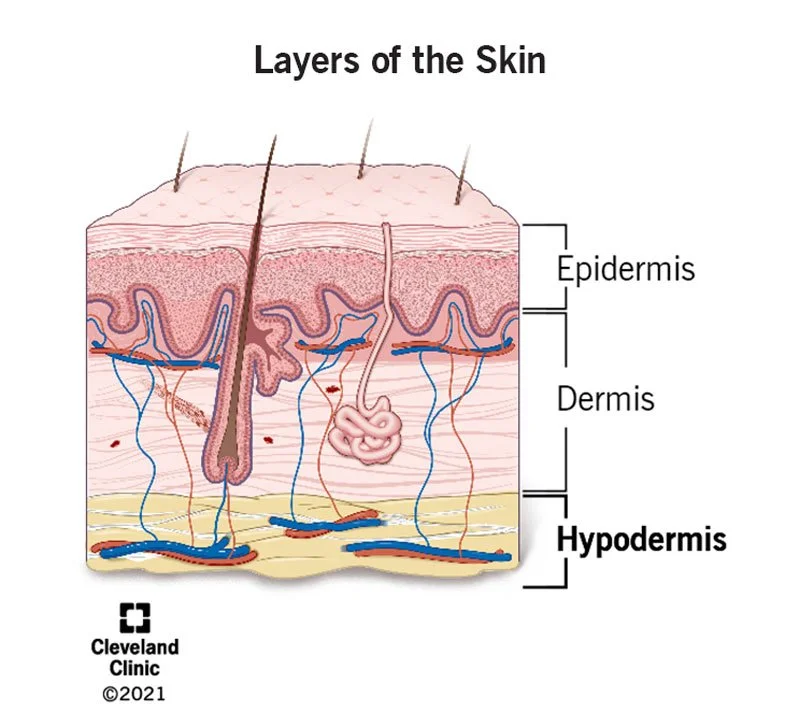
Image 1: Detailed skin anatomy diagram showing the epidermis, dermis, and subcutaneous fat layer with labeled hair follicles, sweat glands, sebaceous glands, nerves, and blood vessels.
Inside the Epidermis
Stratum Corneum: The “Moisture Barrier”
The epidermis itself is made up of multiple sub-layers. The outermost layer is the Stratum Corneum or the “moisture barrier.” The stratum corneum consists of dead, flattened skin cells embedded in a rich matrix of fats including ceramides, cholesterol, and other free fatty acids. This structure seals in moisture and keeps irritants out.
The structure of the stratum corneum is often described as a “brick and mortar” layout. The dead skin cells being the bricks, and the matrix of fats being the mortar.
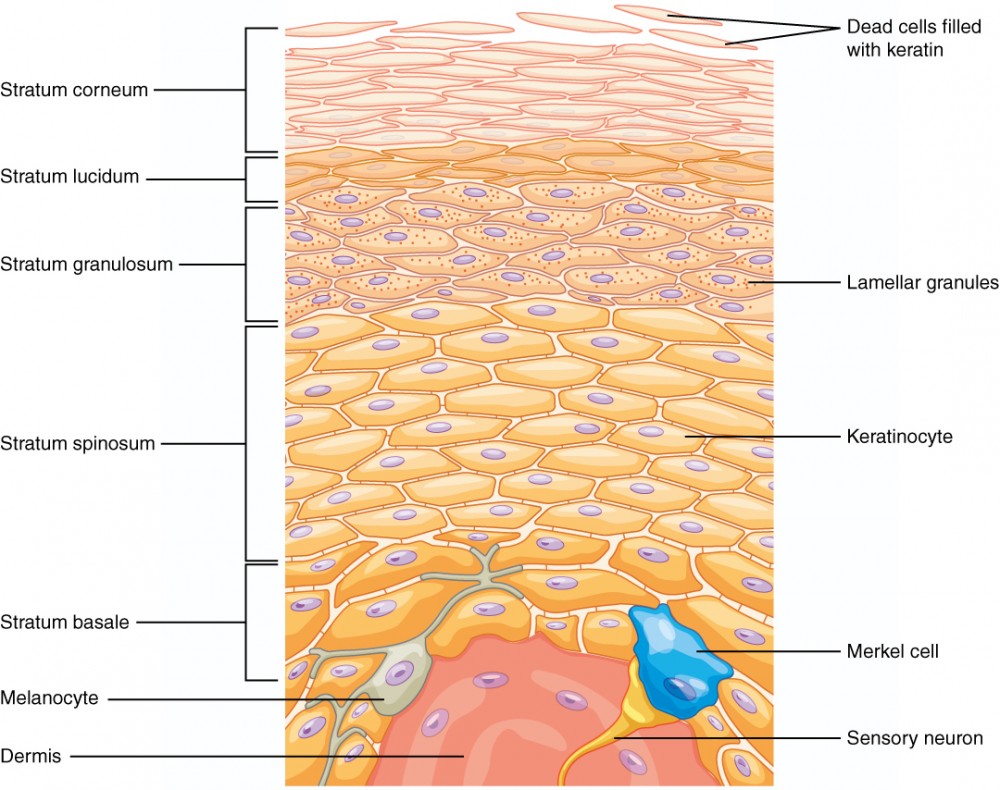
Image 2: A labeled diagram showing all five layers of the epidermis — from the stratum basale at the bottom to the stratum corneum at the top — highlighting how skin cells mature, move upward, and form the protective outer barrier.
What Happens When the Mositure Barrier Is Compromised (or Why Sensitive Skin Is “Sensitive”)
Not all skin behaves the same. Some people’s skin barrier is naturally more fragile or becomes weakened over time or with exposure. Here’s how that happens and why reactions may occur:
Lipid imbalance or deficiency — when ceramides or other lipid components are reduced, the protective lipid matrix becomes less effective.
Increased transepidermal water loss (TEWL) — without a healthy lipid barrier, moisture can escape more easily, leading to dryness, tightness, flaking, and increased sensitivity.
Greater permeability to irritants and allergens — when the lipid “mortar” is weak or disrupted, external chemicals (harsh detergents, strong fragrances, pollutants) can penetrate more easily and trigger irritation or inflammation.
Weaker immune/chemical barrier — a compromised skin barrier can also disturb the skin’s natural pH and microbiome, making it more reactive and increasing the chance of dermatitis or sensitivity.
In short: when the outermost defenses falter, the skin becomes vulnerable and even gentle products may cause stinging, redness, or dryness.
The Inner Layers of the Epidermis
Beneath the stratum corneum are several deeper layers that play essential roles in skin health, healing, and sensitivity. Understanding these layers helps to explain why gentle cleansing matters so much, especially when the skin barrier, or stratum corneum, is easily irritated.
Stratum Lucidum (the “clear layer”)
Found only in thicker areas of skin such as the palms and soles, the stratum lucidum is a thin, translucent layer of dead keratinocytes. It adds:
Extra protection
Additional cushioning
A more durable barrier in high-friction areas
While it doesn’t exist everywhere on the body, it helps show how adaptable and layered your epidermis truly is.
Stratum Granulosum (the “grainy layer”)
This is the layer where cells begin to flatten and fill with keratohyalin granules—the building blocks of keratin.
Here, keratinocytes also start producing lipids that move outward and eventually seal the spaces between cells. These lipids are crucial for a strong moisture barrier.
When the stratum granulosum is disrupted by harsh cleansers or chronic irritation, your skin can lose hydration more easily and become more reactive.
Stratum Spinosum (the “spiny layer”)
Named for its spiny, interlocking appearance, this layer provides structural strength and stability. The stratum spinosum contains:
Keratinocytes linked by desmosomes (tiny protein “rivets”)
Langerhans cells, which help your skin identify irritants and allergens
This is a key layer where your skin begins its immune-defense process — so irritation here can trigger inflammation or sensitivity.
Stratum Basale (the “base layer”)
The deepest layer of the epidermis is where new skin cells are born. The stratum basale contains:
Basal keratinocytes, which divide and push older cells upward
Melanocytes, which make melanin (your skin’s natural pigment + UV defense)
Merkel cells, responsible for light-touch sensation
A healthy stratum basale means healthy skin renewal. Damage here from chronic irritation, over-exfoliation, UV, or barrier disruption can make skin more sensitive and slower to repair itself.
Why Gentle, Well-Formulated Soap Works for Sensitive Skin
A handcrafted cold-process soap, when thoughtfully designed, can actually support and even help restore that barrier rather than strip it away. Here’s how:
Such soaps retain glycerin (a natural humectant formed during saponification) which helps draw and retain moisture in the skin.
By using rich, skin-like lipids (olive oil, shea, gentle fats), the soap can cleanse without stripping the skin’s natural lipids — meaning less disruption of the “brick-and-mortar.”
Because cold-process soap is free from harsh detergents, synthetic sulfates, or unnecessary chemicals, it lowers the risk of irritating a compromised skin barrier.
At The Clean Chemist, we choose oils whose fatty-acid profiles — like oleic, palmitic, stearic acids — mimic skin’s own lipids. That helps maintain barrier integrity, even for reactive skin.
Additionally, for those with very reactive barrier function, an unscented bar — with no essential oils or fragrance additives — is often the safest choice.
What to Avoid — And What to Look For, When Your Skin Is Sensitive
Avoid:
Soaps or cleansers with harsh detergents (SLS, sulfates) that strip lipids.
Products with fragrances, dyes, or essential oils if your skin barrier is fragile. Save the fragrances for when your skin is healthier!
Alcohol-heavy, astringent, or overly foaming cleansers that create a “squeaky clean” feeling (often a sign of over-stripping).
Frequent over-exfoliation
Triple Milled Soaps that remove natural glycerin
Look for:
Mild, balanced cleansers or soaps with skin-mimicking lipids (olive, shea, gentle fats).
Products that retain glycerin or include additional humectants/emollients.
Very simple ingredient lists
Unscented products
Gentle lather, modest cleansing power — enough to clean, not strip.
Patch Testing — A Simple But Smart Step
Before using a new soap broadly (especially if you have sensitivity), try this:
Wet a small patch of skin (inside forearm or behind the ear).
Gently wash with the soap.
Rinse and gently pat dry.
Wait 24 hours.
Observe for any redness, itching, burning, or flaking.
If skin stays calm — that soap is likely a good fit. If irritation appears — discontinue use.
The Clean Chemist’s Promise — Gentle Chemistry, Resilient Skin
We know sensitive skin doesn’t just want “clean.” It wants care, respect, and chemistry that honors what the skin is.
Every bar we craft is built on that philosophy. From our choice of oils to our minimalist formulas, our goal is simple: support skin barrier health, minimize irritation risk, and leave skin feeling clean, soft, and soothed.
Because at The Clean Chemist, our soap is scientifically formulated for sensitive skin.
